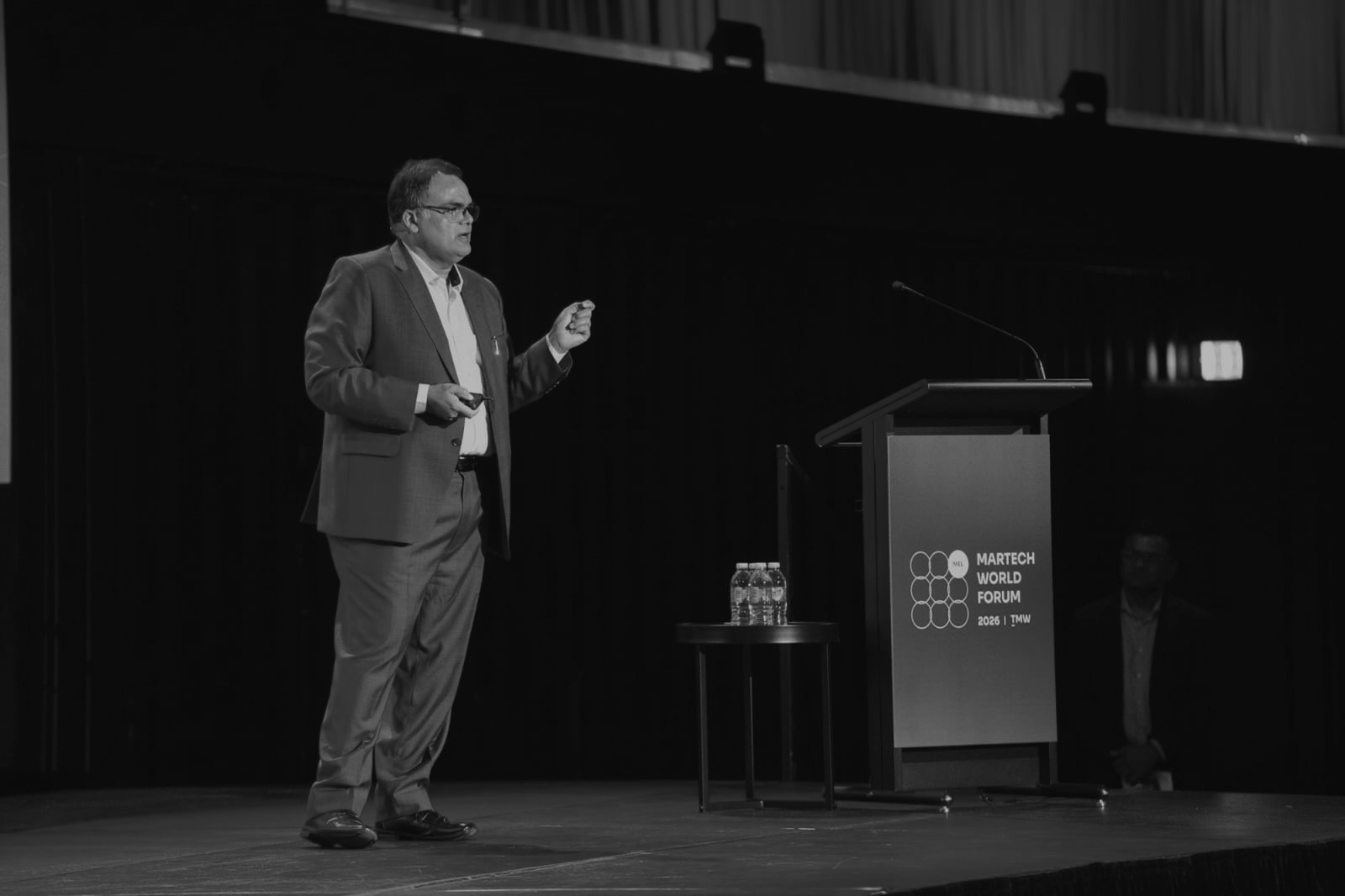
Keynote2026 · Martech World Forum, Melbourne
Agentic Marketing & Human-in-the-Loop
Opening keynote on the operating model behind autonomous marketing.

Enterprise Transformation · AI Operating Models · Process Architecture
For more than 15 years, Satya Upadhyaya has helped some of the largest global enterprise organisations modernise their customer engagement, decisioning, data and marketing technology platforms, having worked in leadership roles with ANZ Bank, Citibank, HSBC Bank, Cochlear etc. and consulted to Calvin Klein, Tommy Hilfiger, Honda, Youi Insurance, Discovery Park, Sanitarium etc. His focus has since moved to a harder problem: designing the operational architecture that AI-enabled organisations need to function.
 Head of Platforms · Decisioning & Channel
 Global Enterprise Architect · Personalisation
 Head of Campaign Operations
 Head of CRM Platforms
 Head of CRM · Lifecycle Marketing
 Digital Engagement Lead
 Analytics & Retention
 Analytics & Process
 Retention & Process
 Customer Engagement · Banking
The Shift
For most of the last 2 decades, enterprise transformation meant implementing systems: choosing the platform, migrating the data, training the teams and measuring adoption. Satya led that work across banking, healthcare, wagering and hospitality, building the CRM, marketing technology, data and decisioning capability that large organisations still run on today.
2023–Present · The Operational Era
The data is largely connected, yet the same friction persists, because the constraint was never only the technology.
2017–2023 · The Personalisation Era
Omni-channel execution meant organisations could finally act on intent at scale.
2011–2017 · The Platform Era
The work became rationalisation, integration and governance across complex, multi-brand environments.
2004–2011 · The CRM Era
The discipline was getting data into one place and acting on it consistently.
In every environment, the same pattern appeared. Organisations kept buying technology, but the real constraint had moved somewhere the software could not reach.
Process design, the coordination of work across teams, and the manual handoffs and delays that sit between a decision and its execution. AI is making those constraints visible. The next phase of transformation will be less about implementing software and more about redesigning how work moves through the organisation.
"Technology implementation is no longer the differentiator. Operational architecture is."
Selected Work
4 recent programmes, each a working system rather than a set of recommendations. Each one takes a recurring operational failure and moves it from human effort into engineered infrastructure.
Complaints arrived through 6 channels into a manual process with no commercial visibility. Guests waited hours, handoffs lost cases, and campaigns kept reaching unresolved guests.
Inbound leads funnelled into one inbox with a person deciding which broker received each. Workable at 20 leads a day, unworkable at 80, and the delay handed warm borrowers to faster competitors.
A 30-person team ran 100–200 campaigns a month with a 30% post-send error rate. The errors started upstream, in ambiguous briefs and misconfigured segments, before any check could catch them.
A customer reaches a decision point online, cannot find the number, switches device, waits on hold, and starts over with an agent. A measurable share give up before they connect.
A five-layer reference architecture for agentic marketing, defining how autonomous agents and human judgement share the work across channels, orchestration, intelligence, governance and data.
A structured diagnostic of why an enterprise decisioning platform stalled on adoption, the root causes behind it, and the automation and agentic roadmap required to unlock its operational value.
Seven end-to-end marketing processes mapped step by step, each classifying where agents operate autonomously and where human leadership remains accountable across the lifecycle.
A multi-agent orchestration system built on n8n that routes guest complaints across channels, triages severity and coordinates resolution, with humans accountable at every escalation point.
Track Record
15 years inside large, regulated organisations, as a permanent leader and as an external architect, across financial services, healthcare, wagering, hospitality and membership loyalty.
Head of Platforms for digital, decisioning and channel execution across the retail bank.
Global Enterprise Architect on a 3-year, $8M personalisation roadmap across AU, US and EMEA.
Head of Campaign Operations on a $120M book of work, with error rates reduced from 30% to under 3.
Head of CRM Platforms for customer engagement across 9 business units and $10M in investment decisions.
Head of CRM for lifecycle marketing and personalisation capability in wagering.
Digital engagement lead building connected experience roadmaps for major banking and telecommunications clients.
Foundational analytics, retention and process roles across banking and membership.
Trusted by CIOs, CMOs and CDOs to unify platforms, reset governance and turn customer technology into commercial results.
AI Operating Models
Success with AI rarely comes down to having the most advanced model. It comes down to understanding how the organisation's own work moves, and having the discipline to redesign it for autonomy without losing control.
Most of the work sits away from the algorithm: deciding which steps can run on their own, which ones still need a person in the loop, and how every step stays auditable in a regulated setting.
Responsible-AI principles, bias-audit requirements and audit-trail standards aligned to APRA, ASIC and Privacy Act obligations.
Identifying where autonomous agents add value above the automation layer, and where they do not belong.
The decision gates, escalation paths and approval points that keep autonomy accountable.
End-to-end redesign that removes duplication, cuts manual intervention and creates repeatable patterns for AI to scale against.
The connective layer between platforms, data, APIs and channels, so AI capability is built in rather than bolted on.
Operating models, enablement programmes and standards that raise AI fluency and adoption across the organisation.
Drawn from keynote work at CMO Connect and the Martech World Forum, a published AI-governance whitepaper with Kantar, and agentic-marketing frameworks developed for executive audiences.
Executive Education
Alongside transformation programmes and operating-model work, Satya has developed executive education, governance and capability-development frameworks designed to help organisations build lasting internal capability rather than dependency on external advisors.
The focus is not training for its own sake.
It is helping leaders, practitioners and teams understand the organisational, governance and operating-model implications of modern customer engagement, marketing technology and AI-enabled transformation.
A practitioner-led executive programme designed for experienced marketing, technology and customer leaders responsible for significant Martech investment, transformation and governance decisions.
A structured diagnostic framework designed to assess organisational readiness for AI-enabled marketing and identify the highest-value operational, governance and capability opportunities.
A governance architecture developed to help organisations deploy AI responsibly while maintaining regulatory oversight, accountability and operational control.
A comprehensive operating-model redesign approach focused on helping organisations transition from traditional execution models to AI-enabled ways of working. Not by adding more tools or more budget, but by making everything you already have work significantly better in the operating system: the connected set of processes, standards, skills and governance disciplines that turn individual capability into collective, repeatable, commercial output.
Executive Education · Thesis
Technology implementation creates capability.Capability development creates transformation.
The most successful transformations occur when organisations understand not only the technology they implement, but also the operating model, governance discipline and leadership behaviours required to sustain it.
Research & Perspectives
Keynotes
Selected speaking engagementsOpening keynote on the operating model behind autonomous marketing.
Closing keynote on the architecture beneath real-time decisioning.
On the shift from marketing automation to AI-driven systems.
On building capability and leadership inside high-performing marketing organisations.
On scaling real-time data capability across the enterprise.
On balancing personalisation with privacy and customer trust.
On turning data and analytics into measurable customer outcomes.
On optimising the Martech stack around the customer journey.
On the capabilities organisations need for what comes next.
On the recurring failure patterns in Martech and how to resolve them.
On the operating models that let marketing move at speed.
On meeting accelerating customer demand for digital engagement.
Publications
Whitepapers & practitioner documentationCampaign Operations: the decisions, craft and accountability that stay human even as execution automates.
Banking, Insurance, Healthcare, Retail, Supermarkets, Entertainment, Telco and Airlines, examined vertical by vertical.
Reactive, Triggered, Predictive and Autonomous next best action, with worked examples from Banking, Telco and Retail.
On why operational architecture, rather than technology, increasingly decides transformation outcomes.
Frameworks
Practitioner-developedGoing from reactive to autonomous to next best action.
Practitioner-developed
Accountability, oversight and audit structures for portfolio capabilities, gaps in current and target state.
Practitioner-developed
The reference design for AI-ready teams, processes and decision rights.
Practitioner-developed
Where approval, escalation and review keep autonomy accountable.
Practitioner-developed
A staged view of organisational readiness and capability growth.
Practitioner-developed
A structured method for diagnosing operational and governance gaps.
Practitioner-developed
They will have the clearest operational architecture.
Most of the platforms are built and the data is connected. What separates organisations now is whether they understand how their own work moves, and whether they have designed it for what comes next. That is the conversation worth having.
For enterprise leaders looking at AI adoption, operating-model redesign, customer engagement transformation or workflow architecture.